
12/09/2026
Blue-light filtering glasses: what they are and when to use them
Understand what blue-light glasses filter, how yellow and red lenses differ and why the time of use matters....
Read articleBy Miguel Chamorro · Published 19/09/2026 · Updated 19/10/2026
A balanced review of blue-light glasses for screens, visual fatigue, sleep and circadian routines, separating measurable filtering from health claims.
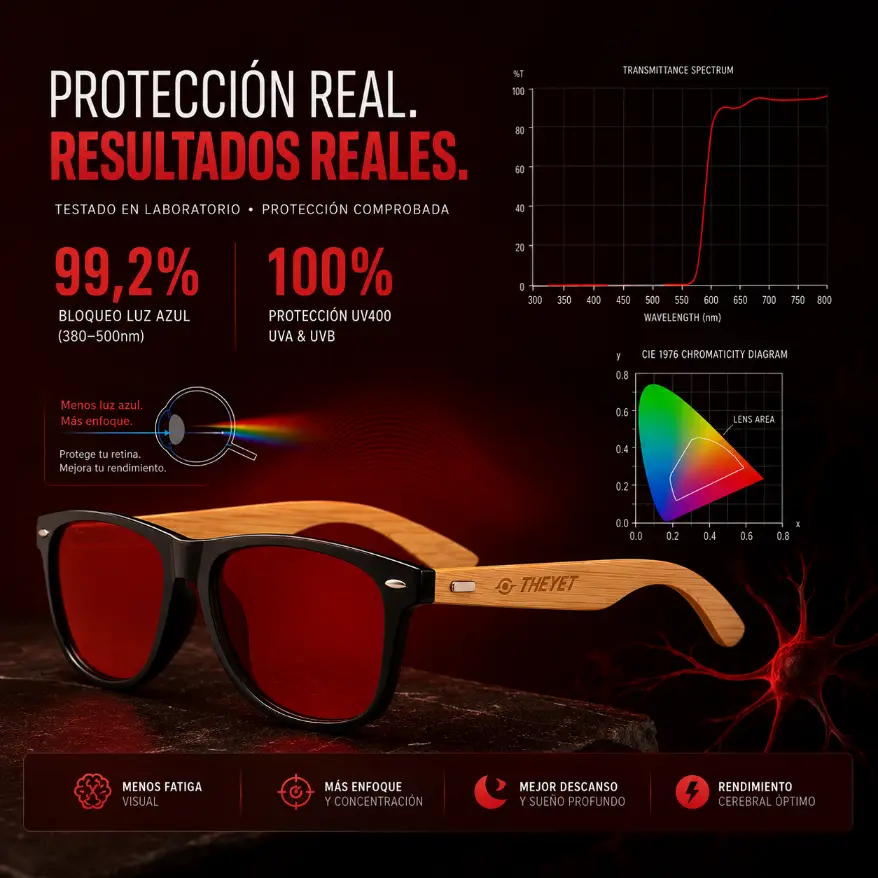
Blue-light glasses can physically reduce selected wavelengths when the lens is designed to do so. That optical property is measurable. It does not automatically prove that every lens improves eye strain, protects the retina or improves sleep.
Current reviews have not shown clear, consistent short-term benefits from blue-light filtering lenses for digital eye strain. Screen discomfort also depends on viewing distance, blinking, dryness, glare, text size, posture and breaks.
There is a plausible circadian reason to manage bright evening light, but study results for glasses are mixed. The lens spectrum, timing, surrounding light and individual routine all influence the outcome.
Clear, yellow and red lenses can have very different transmission curves. A useful evaluation looks at measured spectral performance rather than the phrase “blue-light blocking” alone.
Use glasses as one part of a broader light routine: seek daylight during the day, reduce brightness at night and choose a lens for a specific use. Compare the options in THEYET Health blue-light glasses.
More content
12/09/2026
Understand what blue-light glasses filter, how yellow and red lenses differ and why the time of use matters....
Read articleWe use analytics cookies to understand how the site is used and improve the experience. They are only enabled if you accept them. Cookie policy.